
Click on the link below and it will take you to our website. Each month we publish a magazine that is full of articles for the family. These article are amazing. Especially “Children of Lesser Gods”. Also learn more about Gavin Allison. Gavin sings on our worship team and is a very talented young man. I hope you enjoy it!
The Cave
StandardAugust is back to school month. This makes me think of a trip I did with my high school youth group in Colorado Springs back in 1990. I remember taking them on a weekend trip to the Fulford Cave in White River National Forest near Eagle Colorado. This is not a cave like Mercer Caverns where you get a guided tour down a grand staircase. It is a cave that gets checked every three days by the forest service to make sure no one get lost inside. As I took this group of 16 high school students on the adventure of there lives God taught me a thing or two about sharing my faith. I brought Wayne with me because he knew the cave well. We followed Wayne up the side of a mountain at 11,300 feet. As we got close to the cave I thought I saw the entrance. It looked like a nice wide archway. I was wrong. Two very distressed girls came to me and said they were not going into the cave. They were crying. Robin and I thought they were being a little too dramatic so Robin walked to the front of the group to see the entrance. When Robin got back to me she was crying and said, “Morri, there is no way I am going into that cave.” I knew this would be a challenge for all of us but the lessons we would learn would last for a lifetime. The entrance was a small man-hole with a plastic cover. (See Pictures Below) I lifted the lid and felt the cold black darkness hit me in the face. This hole went right into the side of the mountain and then almost straight down for about 90 feet. I knew this would be a challenge for all of us but the lessons we would learn would last for a lifetime. It took about an hour to get all of us into the cave. Wayne took us all over the cave. Finally we ended up in the Cathedral Room. This was a large room with a 3-story drop off on one side down to a river that ran through the bottom of the cave. Wayne had us all sit well away from the ledge and at least two arms length away from each other. He had us put our flashlight away and take out our candles. (Candles are essential when spelunking) Wayne was the only one with light at this point. He then talked to us about the importance of sharing our faith with our friends. He asked, “Do the other students at your high school know that you are a Christian?” “When was the last time you shared your faith with someone at your school?” Then he said “I want you to imagine for one minute what is would be like to be lost in this cave.” He counted to three and blew out his candle. There we sat alone in pitch-black darkness. Before the minute was up about half the students were in tears. Finally Wayne lit his candle. What a relief! The light was so powerful. Then he said, “What if I took my light and left you in this cave?” “You would be here in darkness because I refused to share my light with you.” Then Wayne made his point. He said, “Your school is like this cave. There are people who are lost in total darkness and you have the light. Many of you have refused to share your light in the past. I hope in the future you will think of this cave and share the light of Jesus Christ with your school.
It was one of the most powerful moments of ministry I have ever experienced. What about you? Are there people around you every day that are walking in darkness. Are you ready to share the light of Jesus Christ with the people you come in contact with? Let’s do it. Let’s go share the life changing message of Jesus Christ with our world!
Shinning His Light
Pastor Morri


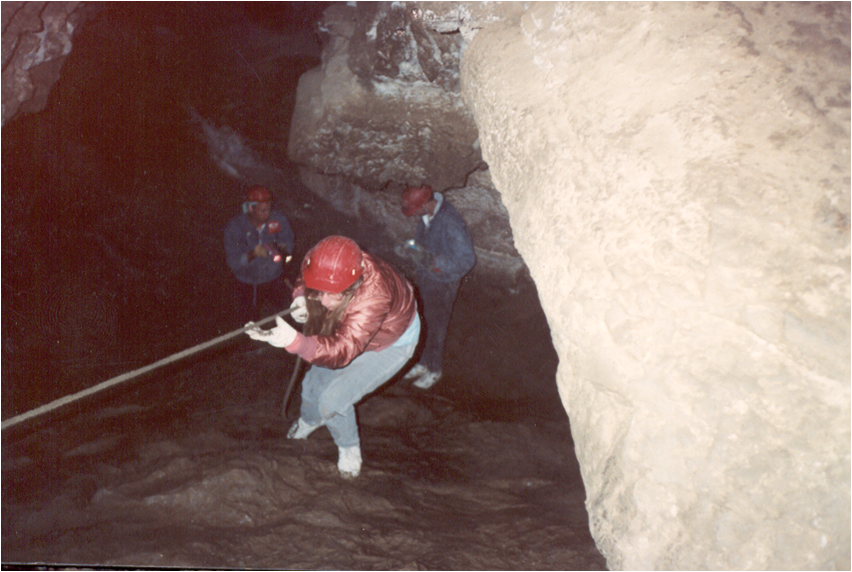
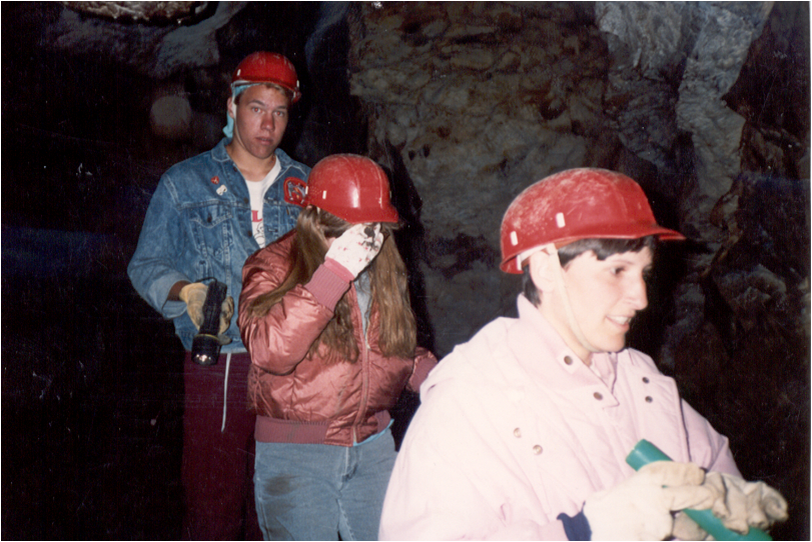
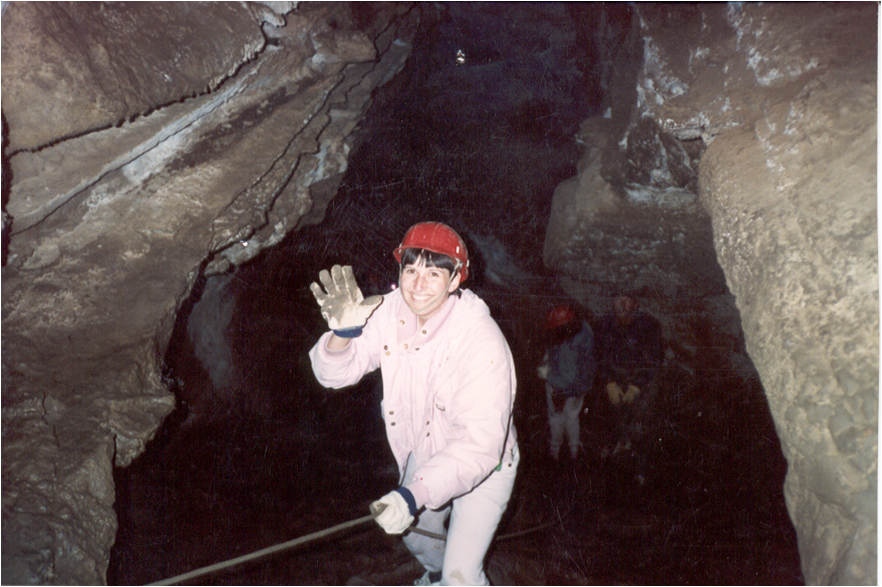 Yes this is Robin in the cave.
Set Free! Christ Arose!
StandardDuring the early Christian era on Resurrection Sunday you would hear this greeting:
“Alleluia, He is Risen!”
“Alleluia, He is Risen Indeed!”
This greeting has been revived during the last 100 years. I’m sure you have heard the greeting many times through the years on Easter Sunday Morning. This greeting makes me want to sing the great hymn written and composed by Robert Lowry in 1874, Christ Arose!
When we sing the song, notice the two different moods of the song. This was intentional by Lowery. The verses are to be slower and in a more somber mood. The chorus is to sung with enthusiasm and praise! Lowry says that this hymn was born out of his devotions. He was reading Luke 24:6-8 6 He is not here; he has risen! Remember how he told you, while he was still with you in Galilee: 7 ‘The Son of Man must be delivered over to the hands of sinners, be crucified and on the third day be raised again.’ ” 8 Then they remembered his words.
Robert began to picture in his mind the events of the crucifixion and resurrection of Christ. Before he realized it, he was at his little pump organ in his house writing and composing “Christ Arose”. It happened almost spontaneously. In fact most of his hymns happened just that way. He spoke of his method for hymn writing saying that he has no set method. When the mood strikes him, no matter where he is he begins to write the song. He says his brain starts spinning and wont shut off. The music is constantly running in his head.
On this Easter week what is running through your head? Galatians 5:16 says, “Live by the Spirit and you will not gratify the desires of your sinful nature.”
Proverbs 4:20 tells us to “Guard your heart”. Some how our brains are connected to our hearts. I don’t mean your physical blood pumping heart. I mean you Spiritual Heart. What we think about directly effects our actions. If we focus on the things of God then this will bring about good actions in our life. If we focus on the world then we will be drawn away from God. There is a video on youtube that expresses this so very well. It is called “Everything” by Lifehouse Church. It starts with Jesus and a girl enjoying God’s creation. As she gets older the things of the world begin to draw her away from Jesus. He tries to get her to come back to Him but she is too distracted by the world. Soon the world has control of her mind and actions. Just before she tries to commit suicide she realizes what has happened and she tries to reach for Jesus. The things of the world are holding her back. Then Jesus steps in and sets her free. Watch the video. It is awesome!
What kind of things in this world are keeping you captive? This would be a great week for you to let Jesus set you free!
The Crown of Control
StandardThe “Triumphal Entry” of Jesus into Jerusalem happened one week before His resurrection. Zachariah 9:9 prophesied, “Rejoice, O people of Zion! Shout in triumph, O people of Jerusalem!
Look, your king is coming to you.
He is righteous and victorious,
yet he is humble, riding on a donkey riding on a donkey’s colt.”
The prophecy is fulfilled in Matthew 21:7-9, which says, “They brought the donkey and the colt to him and threw their garments over the colt, and he sat on it. Most of the crowd spread their garments on the road ahead of him, and others cut branches from the trees and spread them on the road. Jesus was in the center of the procession, and the people all around him were shouting, “Praise God for the Son of David! Blessings on the one who comes in the name of the Lord! Praise God in highest heaven!”
We call the Sunday before Easter Palm Sunday because of the palm branches that were spread out for Jesus as the crowd cried out “Hosanna”! The same crowd a week later cried out, “Crucify Him”.
Why were the people shouting “Hosanna”? Hosanna means save or rescue. The Jews were under Roman rule and they wanted to be rescued. They were waiting for the Messiah. But their idea of the Messiah was a King that would come and conquer Roman military and take control. They wanted a Messiah that would save them from Rome. Jesus did come to save but not with military power. Luke 19:10 says, “For the Son of Man came to seek and save those who are lost.” He came to save us from the penalty of our sin. The punishment we deserve is eternal separation from God. Thankfully, by His grace, we do not have to serve a sentence of spiritual death. We are saved by His grace from the penalty of our sin.
This Sunday morning March 24, 2013 our foundation hymn is “Crown Him with Many Crown”. The “Crown” symbolizes power and authority. Have you crowned Jesus the Lord of your life? It is typical for us to “Crown” Him one day and then take the crown away the next. As you sing this hymn take a look at your life and ask yourself if you have given Jesus complete control of your life.
Our songs for the morning include:
• Crown Him with Many Crowns
• Hosanna (Praise is Rising)
• Holy is the Lord
• Holy Holy Holy Lord God Almighty
A Love Song
StandardWilliam Featherson lived to be almost 27 years old. We don’t know much about his life other than he was born on July 24, 1846 and he died just before his 27th birthday. There is one thing of note that he did that we are familiar with, he wrote a poem. William wrote the poem when he was 16 years old. His poem is a deep expression of his love for his Lord. Then 14 years later, 3 years after William’s death, Adoniram Gordon put music to this beautiful love poem. Since the song was published it has been printed in almost every evangelical hymnal.
There is one other story about this love poem. I found this story at http://www.biblestudycharts.com. Here is the story copied from that site.
“A Protestant Minister once related the following story regarding this hymn.
to a large audience in one of the Rev. E. P. Hammond’s meetings in St. Louis.
“A young, talented and tender-hearted actress was passing along the street of a large city. Seeing a pale, sick girl lying upon a couch just within the half-open door of a beautiful dwelling, she entered, with the thought that
by her vivacity and pleasant conversation she might cheer the young invalid. The sick girl was a devoted Christian, and her words, her patience, her submission and heaven-lit countenance, so demonstrated the spirit of her religion that the actress was led to give some earnest thought to the claims of Christianity, and was thoroughly converted, and became a true follower of Christ. She told her father, the leader of the theater troupe, of her conversion, and of her desire to abandon the stage, stating that she could not live a consistent Christian life and follow the life of an actress. Her father was astonished beyond measure, and told his daughter that their living would be lost to them and their business ruined, if she persisted in her resolution. Loving her father dearly, she was shaken somewhat in her purpose, and partially consented to fill the published
engagement to be met in a few days. She was the star of the troupe, and a general favorite. Every preparation was made for the play in which she was to appear. The evening came and the father rejoiced that he had won
back his daughter, and that their living was not to be lost. The hour arrived; a large audience had assembled. The curtain rose, and the young actress stepped forward firmly amid the applause of the multitude. But an unwonted light beamed from her beautiful face. Amid the breathless silence of the audience, she repeated:
‘My Jesus, I love Thee, I know Thou art mine;
For Thee all the follies of sin I resign;
My gracious Redeemer, my Saviour art Thou;
If ever I loved Thee, my Jesus, ’tis now.’
This was all. Through Christ she had conquered and, leaving the audience in tears, she retired from the stage, never to appear upon it again. Through her influence her father was converted, and through their united
evangelistic labors many were led to God.”
As we sing “My Jesus I Love Thee” make sure to make it a love song between you and God.
The Song That Happened
StandardSome songs take writers months to compose, others just happen. The song, “Trading My Sorrows”, was not written, it just happened. It happened in the middle of a worship service. Darrell Evans was leading the congregation through a time of prayer. The band was playing softly behind as Darrell prayed. People were coming forward and kneeling. They were figuratively laying things from their lives on the altar. It was a very tender moment. Darrell began to think about his own life. What would he place on the altar? He pictured himself kneeling at the foot of the cross. Darrell thought of how often he had failed. He thought about the shame, the sorrow and the pain in his own life. He thought, “Man, I’d like to trade those things in.” He began singing the words he was thinking. “I’m trading my sorrows. I’m trading my shame. I’m laying them down for the joy of the Lord.” He started out singing these words soft and slow but as the words continued to flow he began to play faster and with more excitement. The tender moment became a moment of celebration. People started lifting their hands in worship and surrender as Darrell started sing, “Yes Lord, Yes Lord, Yes Yes Lord” as a response to God. The song was born.
Later that week he went to Scripture to complete the song. He came across II Corinthians 4:8-9, “We are hard-pressed on every side, yet not crushed; we are perplexed, but not in despair; persecuted, but not forsaken; struck down, but not destroyed.” Then from Psalm 5, “Weeping may endure for a night,
But joy comes in the morning.” Darrell says, “Joy isn’t tested when things are great. Joy and strength are tested when things are difficult. Where are you going to run when things get hard and you don’t understand? I’m going to run to you, God. I don’t get it, but I’m going to trade this in for joy and just know that walking with You is more than enough to carry me through.”
What will you place at the cross. What would you like to “Trade in”? Today is the day to deal with God. He will take your burden and give you joy!
900 Years Later
StandardFrederick M. Lehman wrote about love, the love of God. In fact that is the title of his hymn, The Love of God. He wrote the hymn while sitting on an empty lemon crate in Pasadena California. He had pastored mostly in the Midwest but in 1917 he found himself without a church and struggling financially. He took a job at a packing company in Pasadena. He would move thirty tons of lemons and oranges each day. He loved music and one morning he had a song in his head. During a break he sat down wrote two stanzas. He went home that night and sat at his piano and the tune came to him. The problem was that he needed a third stanza. All the hymns of that day had three stanzas. He remembered a sermon he heard recently. The preacher had read a poem that fit perfectly.
Could we with ink the ocean fill
And were the skies of parchment made
Were ev’ry stalk on earth a quill
And ev’ry man a scribe by trade
To write the love of God above
Would drain the ocean dry
Nor could the scroll contain the whole
Tho’ stretched from sky to sky
The problem was he did not know who wrote these words. He used the verse anyway. Today we know that a Jewish poet in Germany who lived during the eleventh century, Meir Ben Isaac Nehorai, wrote this third stanza. His words, from the eleventh century, fit perfectly with the melody Frederick wrote in the twentieth century. Meir Ben Isaac Nehorai never dreamed that a verse he wrote would be sung by thousands in a land of which he had never heard. What a beautiful expression of Gods love found in this hymn.
God uses us in many different ways; it may be today or may be 800 years from now!
Let the Rocks Cry Out!
StandardLuke 19:40 “I tell you,” he replied, “if they keep quiet, the stones will cry out.”
The foundation of the New Testament is the Old Testament. The foundation of the Old Testament is Genesis 1:1 “In the beginning God created the Heavens and the Earth.” St. Francis of Assisi wrote our foundation hymn for February 3, 2013, “All Creatures of Our God and King”, 788 years ago in 1225. He used Psalm 148 for his text.
7 Praise the Lord from the earth,
you great sea creatures and all ocean depths,
8 lightning and hail, snow and clouds,
stormy winds that do his bidding,
9 you mountains and all hills,
fruit trees and all cedars,
10 wild animals and all cattle,
small creatures and flying birds,
11 kings of the earth and all nations,
you princes and all rulers on earth,
12 young men and women,
old men and children.
In Luke chapter 19 we find the disciples and followers of Jesus leading him down the street on a donkey. They are shouting and praising the Lord. “Blessed is the King who comes in the name of the Lord.” The Pharisees did not like hearing the people proclaiming Jesus as the “The King who comes in the name of the Lord”. So they told Jesus to make his followers “Stop saying things like that”. Jesus then presents the “Law of suppression”. He replied, “If they kept quiet, the stones along the road would burst into cheers!” Meaning that all of nature knows that He is the King who comes in the name of the Lord and if men will not say these things then nature will.
I remember as a kid swimming in my pool in the backyard. We would always have a beach ball or two to play with. You could play tag with a beach ball. Play volleyball with a beach ball or just float on the beach ball. One thing you could not do with a beach ball was hold it under water for more than a few seconds. It would always pop up. And it would not pop up quietly. It would come shooting out of the water like a man desperate for air.
This is what I think Jesus meant. If mankind stops praising Him all nature will CRY OUT! Not in a quiet whisper. The rocks and stones will shout loud so everyone will hear. “BLESSED IS THE KING WHO COMES IN THE NAME OF THE LORD!”
Of Mice and Hymns
StandardAccording to Norman Mable, in his book “Popular Hymns and their Writers, Page 179, “From an early age, Isaac Watts displayed a propensity for rhyme. Once, he had to explain how he came to have his eyes open during prayers:
A little mouse for want of stairs
Ran up a rope to say its prayers.
Receiving corporal punishment for this, he cried:
O father, father, pity take
And I will no more verses make.”
Growing up in church Watts was only allowed to sing the words of the Psalter, which is a book containing the Psalms. It would be “Disrespectful to God” to sing any other words. These Psalms were put to a droning style of music. He complained to his father and his father told him to do something about it. Over the next two years he wrote over 200 hymns. One of those hymns was O God Our Help in Ages Past. It was a time with very little religious freedom. Isaac’s father had been arrested twice for his religious views. Isaac had become known a “Radical Churchman” for writing songs that did not quote the Bible exactly. It was during this time of fear that he paraphrased Psalm 90 and wrote this great hymn.
“O God our help in ages past our hope for years to come
Our shelter from the stormy blast and our eternal home
Under the shadow of Thy throne still may we dwell secure
Sufficient is Thine arm alone and our defense is sure
O God our help in ages past our hope for years to come
Be Thou our guide while life shall last and our eternal home”
Watts was able to take Scripture, turn it into a song to encouragement those who hear and sing its words. Through his paraphrase we sing that God has been with us and will be with us thru all time. He is our defense! He is our hope! He is our guide! Finally, God is the eternal home for those who have trusted Him. One day when we each breathe our final breath we will find ourselves in the presence of the Almighty! As you sing this hymn remember the “Sufficient Arms” of God your Father. No matter what life brings your way we will dwell secure in His eternal home.
Heartburn for Jesus!
Standard1961 John F. Kennedy takes over as President
1961 The Beatles perform for the first time at the Cavern Club
1961 The Bay of Pigs Invasion of Cuba
1961 President Kennedy announces Apollo to put a man on the moon
1961 The Six Flags Over Texas theme park opens
1961 Roger Maris hits 61st home run in the last game of the season
1961 Hymn, Heaven Came Down and Glory Filled My Soul, was written.
In my first church, Oakdale Church of the Nazarene 1985 – 1990, we would have an evening service on Sunday with testimony time. People would stand in between songs and tell about what God is doing in their lives. I remember one gentleman by the name of Lloyd Moore, that stood up and in a gruff voice, like Jimmy Durante’s voice, said, “I’ve got heartburn! Heartburn for Jesus”, then he sat back down. I am sure there were many wonderful testimonies given during those services but the “Heartburn testimony” is the only one I remember. Heartburn for Jesus! I can still hear him.
In 1961, songwriter John Peterson was leading a service much like I just described. In that service a gentleman stood to express how he felt the night that he accepted Jesus. He said he felt like, “Heaven came down and glory filled my soul”. John could not get those words out of his head. He decided to use this testimony as a theme for a song. In one week he was able to write the tune and the lyrics to our Foundation Hymn for Sunday January 20, 2013.
Do you remember the day you turned your life over to Jesus? For me it was August 19, 1974. I was in Jr. High. I got a ride to Monte Vista Chapel with my friend’s mom, Judy Fiorini. I went because there was this really cute girl named Robin that I had a crush on. (She is now my wife) After Sunday School Jerry Balswick (Balswick Tire) took me aside and asked me, “Morri, if you died tonight do you think you would go to heaven?” I decided that day that I wanted to spend eternity in Heaven. Jerry led me in a payer and I received Jesus as my Savior!
The hymn writer John Peterson wrote this hymn of testimony about receiving Christ as personal Savior. As we sing it think of the day Christ came into your heart.
Verse 1
O what a wonderful wonderful day
Day I will never forget
After I’d wandered in darkness away
Jesus my Savior I met
O what a tender compassionate friend
He met the need of my heart
Shadows dispelling with joy I am telling
He made all the darkness depart
Chorus
Heaven came down and glory filled my soul
When at the cross the Savior made me whole
My sins were washed away
And my night was turned to day
Heaven came down and glory filled my soul
John W. Peterson
© 1961 John W. Peterson Music Company
 Morri Elliott